Solo Travel in Iceland: A Story of Weather, Roads and Wild Camping
The hire car was a small, tired estate with a sticker on the dashboard listing three phone numbers I hoped never to use. I collected it at Keflavík in horizontal rain, drove forty minutes to a campsite on the Reykjanes peninsula, and ended up sleeping in the boot because the tent poles had gone into the wrong bag. That first night I lay listening to the wind reshape the car and wondered, briefly, whether I should have booked a hotel.
Twelve days later I came back around the other side of the country, slightly thinner, considerably better at reading clouds, and quite certain I would do it again.
The Forecast Is Part of the Route
Checking the weather once a day is pointless. In Iceland the wind does not simply accompany a storm; it makes the decisions. A gust can fold a car door the wrong way if you let it swing, and a campsite that feels sheltered at nine in the evening can be unbearable by midnight.
Twice a day I opened the Met Office site and the road administration's maps — over breakfast, then again at a petrol station in the afternoon. I looked at three things: wind speed, wind direction, and whether any road carried a coloured warning. Rain I could ignore. Wind I could not.
Dressing for weather you cannot beat
I stopped trying to stay dry and concentrated on staying warm instead. A wool base layer, a fleece, and a shell with a hood that stays up in a gale do more for morale than any number of forecasts. Wet is survivable if you are warm. Cold and wet together ends the day early.
One habit worth copying: check the forecast for the pass you are crossing, not the town where you are eating lunch. High routes close, and they close fast.
Route 1 Has Its Own Language
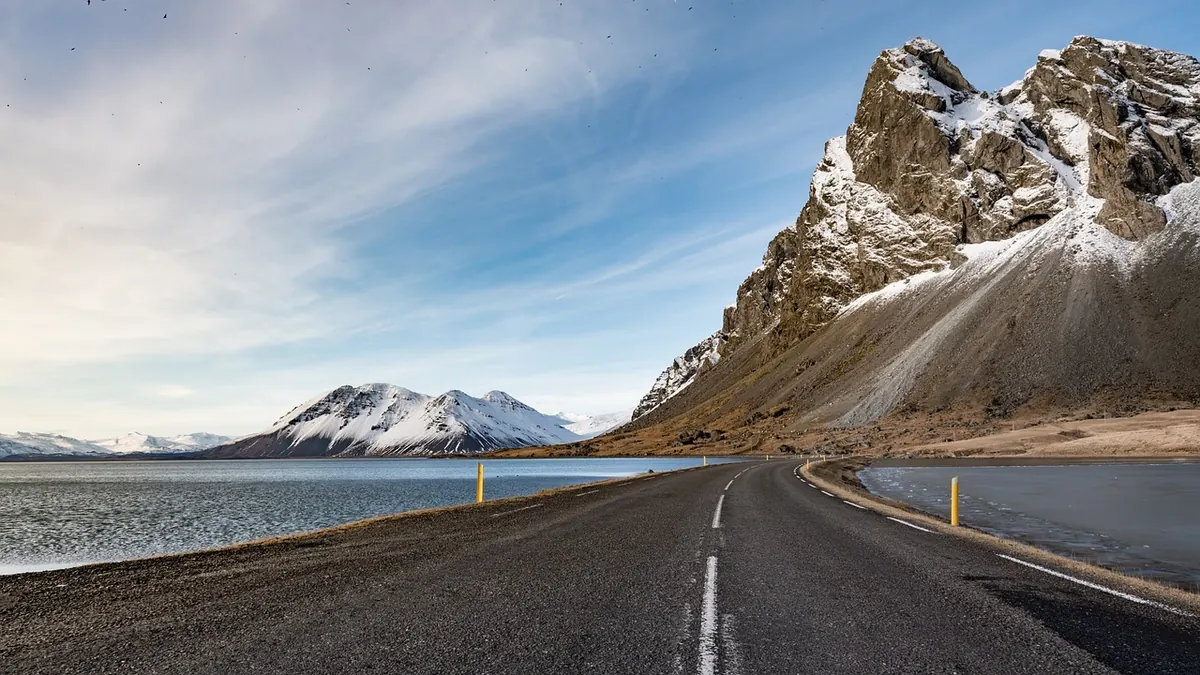
The Ring Road is not difficult driving. It is long driving, and the character changes every few hours: smooth tarmac across the south, gravel and single-lane bridges in the east, long empty straights in the north where the only moving thing is a sheep deciding whether to move at all.
Malbik endar
Those two words mean the tarmac ends. On my first gravel stretch I slowed to forty and gripped the wheel like it owed me money, while a local in a small hatchback sat patiently behind me. Gravel roads have a posted limit for a reason; driving far below it creates its own hazard. Better to hold a steady, sensible speed and pull over to let people past.
Fuel, cards and single-lane bridges
In the east fjords and the north-west, stations thin out. My rule was simple: if I passed a pump and the tank was under half, I filled it. Most pumps are unattended and want a card with a PIN, so tell your bank you are travelling before you go, and keep a second card in a different bag.
Single-lane bridges work on trust. Slow down, look, and if someone is already on it, wait. The same applies to blind crests, which is where you will meet a sheep, a camper van, or both.
Camping Alone: The Etiquette Nobody Writes Down
Wild camping in Iceland exists, but it is narrower than the internet suggests. Camping on uncultivated land away from settlements is allowed in some places for a single night, but not on farmland, not on fenced ground, not in national parks, and not where signs forbid it. In practice, most of the ground you would actually want to use is one of those things. Ask at a farm, or pay for a campsite.
Campsites are where solo travel gets sociable, and the unwritten rules matter more than the facilities:
- Arrive between late afternoon and early evening. Turning up at midnight and pitching by torchlight over someone's guy ropes is not a warm introduction.
- Pay, even when nobody is watching. Many sites have a box, a machine or an online payment. Wardens notice who skipped it.
- Pitch with your back to the prevailing wind and think about where your tent will be if it shifts two metres overnight.
- Do not colonise the only picnic table or spread wet gear across three benches.
- Wash up in the washing-up sinks, not the shower, and never tip grey water onto the grass beside the kitchen.
- Keep quiet after eleven. Vans carry sound in a way tents do not.
- Leave the drying room better than you found it. Someone will arrive after you, soaked, at nine at night. I was that person twice.
The Night the Tent Lost
The storm arrived on my eighth night, at a small site in the east. I had pitched badly — side-on to the wind — and at about two in the morning a pole snapped with a sound like a gunshot. I spent twenty minutes wrestling wet nylon in the dark before admitting defeat and moving into the car, where I slept badly and woke to a campsite full of people quietly pretending not to watch.
A German couple in a converted van gave me coffee and a spare peg. The warden let me use the workshop to dry the flysheet. By ten the sun was out, the road was open, and I drove to the nearest swimming pool — geothermal, outdoors, open early — which remains the cheapest bath and the best company I found anywhere in the country.
That is the shape of solo travel in Iceland. Things go mildly wrong, and then someone helps you, and you carry on with a better story than you would have had otherwise.
Planning It: What I Would Tell a Friend
Build in buffer days. A ring road done in seven days is driving, not travelling, and one closed road will undo the whole schedule. Book the first and last night, leave the middle loose, and tell someone at home roughly where you expect to be each evening.
Offline maps, a power bank, a head torch, a proper towel, a thermos and a paper book cover most emergencies. Midges at Mývatn in summer are real, and a head net costs almost nothing. Iceland is largely cashless, so a working card matters more than a wallet of notes.
Finally, check that your travel insurance covers what you actually intend to do, especially if that includes driving on remote gravel roads or hiking away from marked paths. If you have a medical condition, speak to your GP or insurer before you go — the distance between services in the interior is worth taking seriously.
Photo: Ludo-Photos / Pixabay
Adventure Quests in New Zealand: 10 Challenges for Your Bucket List
Ten hiking, paddling and cycling challenges across New Zealand's North and South Islands, with honest...
The Ultimate Cold-Weather Camping Kit List for Weekend Adventures
How to stay warm and safe below zero, from sleep systems and insulation to stoves, fuel and the safety kit...
About Us